
The Impact of UK Certification on Career Growth in the 6th Largest Economy

In today’s competitive global job market, professionals are increasingly looking for ways to demonstrate their knowledge, skills and commitment to continuous development. As employers become more focused on measurable capabilities, qualifications and professional credentials can play an important role in helping individuals communicate their expertise.
The United Kingdom has a significant position in the global economy, with an established presence across business, education, finance, technology and professional services. This international standing has contributed to the global visibility of UK education and professional development.
For professionals considering UK certification career growth, the value of a credential should not be based solely on the country’s economic position. The quality of the programme, the organisation behind it, the assessment process, the relevance of the skills developed and the ability to verify the credential are important considerations.
This is where quality assurance, accreditation and digital certification become particularly relevant.
The Importance of the UK’s Economic Standing
The UK is one of the world’s major economies and has an established international presence in business, finance, education, technology and professional services. Its economic influence has helped create an environment in which UK-based education, training and professional development are visible to learners and organisations around the world.
Economic strength should be viewed as a context for credibility rather than proof of every individual credential.
A certificate carrying a UK connection does not automatically guarantee international acceptance, employment or career advancement. Professionals should instead consider what the credential represents, how the programme has been assessed, whether appropriate quality assurance is in place and whether the achievement can be independently verified.
UK International Qualifications (UKIQ) positions itself as a Global Quality Assurance & Skills Development Partner, supporting training providers, educational institutions, employers and professional organisations through qualifications, recognition, accreditation, certification and workforce skills development.
Its qualifications framework provides a structured approach to reviewing programmes according to learning complexity, depth, practical application and professional responsibility.
This makes the quality and structure behind a qualification an important part of the certification process.
The Value of UK Certification
The term “UK certification” can refer to different types of credentials, making it important for professionals to understand exactly what a particular qualification represents before enrolling.
UKIQ’s qualifications framework includes six review levels, from Level 1 through Level 6. These levels indicate the expected complexity, depth, practical application and professional responsibility associated with a programme.
UKIQ clarifies that these qualification levels should not automatically be interpreted as UK-regulated qualifications or as direct equivalents to GCSEs, A Levels, diplomas or university degrees.
This distinction is important when evaluating UK accredited qualifications.
The value of a qualification is influenced by the quality and relevance of the learning behind it. A professional qualification that develops skills directly related to an individual’s career objectives can provide more meaningful value than a credential selected simply because it has an international or UK association.
Accreditation and Quality Recognition
Quality assurance provides another important layer of confidence.
UKIQ’s Quality Assured Training Recognition is designed to independently review training programmes and their quality processes. The framework considers areas such as programme design, learning structures, assessment methodologies, quality controls and learner support.
For training providers, this creates a framework through which they can demonstrate their commitment to quality.
For learners and employers, quality recognition can provide additional information about the standards and processes surrounding a programme.
UKIQ’s accreditation services similarly support eligible training providers and educational organisations seeking independent recognition of their programmes and institutional practices.
When professionals evaluate a UK qualification, the quality assurance, assessment and recognition framework behind the credential should therefore receive as much attention as the certificate itself.
How UK Certification Can Support Career Growth
Certification alone cannot guarantee a promotion, higher salary or a new job. Career progression depends on many factors, including professional experience, performance, skills, employer requirements and the individual’s ability to apply what they have learned.
Nevertheless, a relevant and quality-assured qualification can support career development in several practical ways.
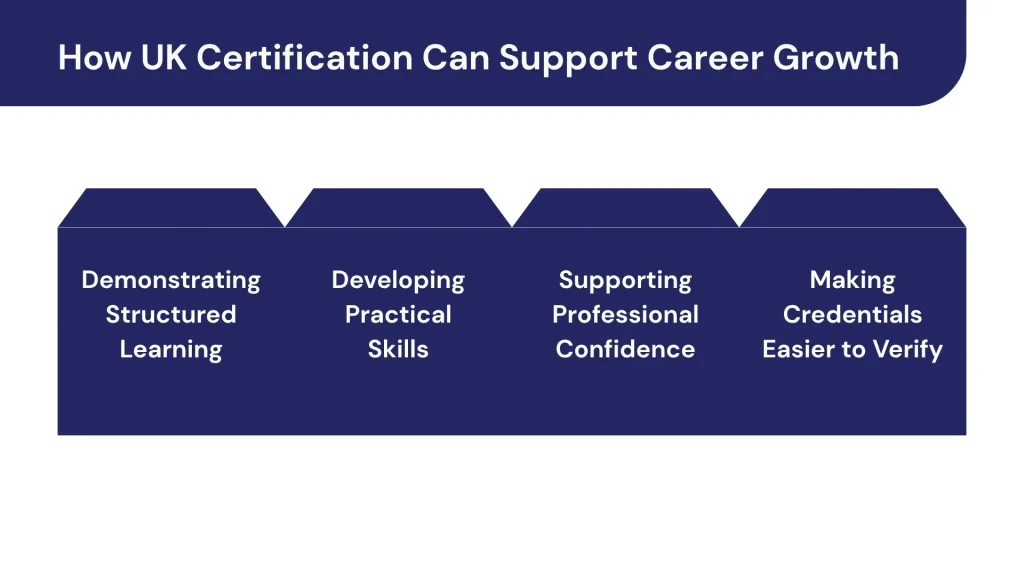
Demonstrating Structured Learning
One of the clearest benefits of certification is the ability to demonstrate structured learning.
Professionals may gain knowledge through work experience, self-learning or informal development, but a completed qualification can provide documented evidence that they have followed a defined learning pathway.
UKIQ’s qualification framework evaluates programmes according to different levels of learning complexity and professional application. This provides a structured context for understanding what a particular programme is designed to develop.
For professionals, this can help strengthen a CV or professional profile when the qualification is relevant to their intended career path.
Developing Practical Skills
Career development is not only about collecting credentials. The skills developed through learning are often the more important outcome.
UKIQ focuses on skills development and workforce capability, with services covering areas such as leadership, talent development, learning and development strategy and skills consultancy.
A professional undertaking relevant learning can therefore use certification as part of a broader development strategy, combining formal learning with practical experience and workplace application.
Supporting Professional Confidence
Structured learning can help professionals build confidence in areas where they want to improve.
Employees preparing for greater responsibility may pursue learning in leadership and management. Professionals moving towards digital roles may develop knowledge in areas such as IT, AI or data analytics.
The qualification itself does not guarantee advancement, but the combination of relevant knowledge, practical skills and documented learning can strengthen a professional’s overall career profile.
Making Credentials Easier to Verify
Another increasingly important factor is verification.
In a digital employment environment, employers and organisations need reliable ways to confirm that credentials are genuine.
UKIQ’s Digital Certification Platform provides digital certification and verification capabilities, allowing credentials to be checked through its verification infrastructure. Digital certificates can include verification features such as QR codes and unique digital identifiers.
This can make it easier for professionals to demonstrate their achievements and for relevant third parties to confirm credential information.
For modern professionals, the benefit of certification therefore extends beyond possessing a certificate. A credential that can be verified when required provides an additional layer of transparency.
Employer Perception of UK-Certified Professionals
Employer perception of a qualification can vary depending on the industry, organisation, role and specific credential.
Employers may consider the relevance of a qualification to the role, the skills and knowledge it represents, the assessment process, the organisation involved in its recognition or quality assurance, the ability to verify the credential and the candidate’s professional experience.
This is why quality assurance and verification matter.
UKIQ’s digital certification infrastructure is designed to support credential verification, while its quality recognition services provide a framework for evaluating training programmes and quality processes.
For professionals, a UK-certified credential can form part of a broader evidence-based professional profile.
International employers may have their own requirements, and regulated professions may require specific licences, registrations or qualifications. Professionals should therefore check the requirements of their target employer, profession and country.
Industries Where UK Certification Can Carry Weight
Different industries place different expectations on qualifications and professional development. The usefulness of a credential therefore depends heavily on how closely it matches the needs of the role.
Finance
Finance and professional services are knowledge-intensive fields where continuous development, professional competence and strong business skills can be important.
Professionals may pursue additional learning in areas such as leadership, management, business development and professional skills to strengthen their capabilities.
A relevant UK qualification can contribute to that development, particularly when combined with practical experience and industry knowledge.
Technology
Technology continues to evolve rapidly, creating an ongoing need for professionals to update their knowledge.
UKIQ’s Quality Assured Training Recognition framework includes areas such as digital skills, IT, artificial intelligence and data analytics.
Professionals working in technology or moving towards digital careers can therefore consider relevant certification as one component of their continuing skills development.
The most valuable choice is generally the qualification that addresses a genuine skills requirement rather than one selected simply for its title.
Healthcare
Healthcare professionals operate within highly regulated environments, meaning that qualifications and professional credentials must be considered alongside applicable regulatory and licensing requirements.
UKIQ’s recognition framework includes healthcare and wellness among its areas of training recognition.
A quality-assured learning programme can support continuing development, but it should not be confused with statutory professional registration or licensing where those requirements apply.
Education and Leadership
Education, training and leadership are areas where continuous professional development can play an important role.
Professionals seeking management or leadership responsibilities may benefit from structured learning in leadership, talent development, organisational development and learning strategy.
UKIQ’s services include Leadership & Talent Development, Learning & Development Strategy and Workforce Skills Development, creating opportunities for organisations to approach professional development as part of a wider workforce strategy.
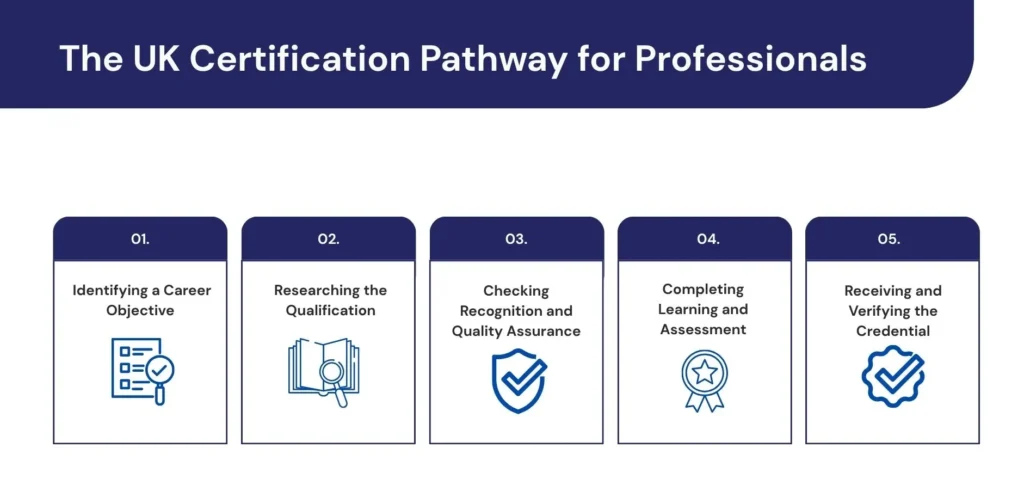
The UK Certification Pathway for Professionals
Professionals considering a UK qualification can approach the process strategically.
1. Identifying a Career Objective
The first step is establishing the professional skill or career direction that the qualification should support.
Leadership development, digital skills, professional advancement and career transition are examples of objectives that can guide qualification selection.
A clear objective makes it easier to select relevant learning.
2. Researching the Qualification
Before enrolling, professionals should examine the qualification’s level, learning objectives, assessment methods and intended outcomes.
UKIQ’s qualifications framework provides six levels for reviewing programmes according to their complexity, depth, practical application and professional responsibility.
Understanding the framework helps learners make informed decisions rather than choosing a qualification based solely on its title.
3. Checking Recognition and Quality Assurance
Where applicable, professionals should examine whether the programme or training provider has been accredited or recognised through an appropriate quality-assurance process.
UKIQ provides accreditation and Quality Assured Training Recognition services for eligible organisations and programmes.
This provides learners with additional information about the quality framework surrounding their chosen learning pathway.
4. Completing Learning and Assessment
UKIQ generally works through approved or accredited institutions and training providers rather than directly delivering every course itself.
Depending on the programme, learners may therefore complete their learning and assessment through the relevant training provider.
UKIQ also provides digital learning and assessment solutions that can support training organisations in delivering structured learning and assessments.
5. Receiving and Verifying the Credential
After successful completion, digital certification provides another important layer of transparency.
UKIQ’s Digital Certification Platform supports digital certificates and credential verification, allowing relevant stakeholders to check qualification information.
This makes the achievement easier to demonstrate when applying for employment, pursuing professional development or presenting evidence of learning to an organisation.
How Organisations Can Partner With UKIQ
The impact of UK certification extends beyond individual professionals.
Training providers, academies and educational institutions can work with UKIQ to strengthen their programmes through accreditation, quality recognition and partnership opportunities.
UKIQ’s partnership model supports eligible institutions and training providers seeking to develop and deliver quality-assured learning programmes.
Through its broader ecosystem, UKIQ combines qualifications, quality assurance, digital assessment, certification and workforce skills development.
Its services can support organisations looking to improve training quality, create structured learning pathways and strengthen the way learner achievements are documented and verified.
For employers, this approach can also connect learning and development with broader workforce objectives.
For training providers, the objective is not simply to issue more certificates. It is to build learning programmes with clear outcomes, appropriate quality controls and credible verification mechanisms.
Building Career Growth Through Quality, Skills and Verification
The impact of UK certification on career growth should be understood as part of a wider professional development journey.
The UK’s position as a major global economy provides an important context for the international visibility of UK education, business and professional services. However, the economic strength of a country alone does not guarantee that every certification will be accepted by every employer or institution.
The real value lies in understanding what a qualification represents.
Quality assurance, relevant learning outcomes, appropriate assessment, professional skills development and reliable verification can all contribute to a stronger credential experience.
For professionals, a relevant UK qualification can help demonstrate structured learning, support skills development and provide verifiable evidence of achievement. For training providers and organisations, accreditation, recognition and partnership can provide structured approaches to developing quality-assured learning programmes.
UKIQ brings these elements together through its qualifications framework, accreditation and quality recognition services, digital certification and verification infrastructure, workforce development services and institutional partnerships.
Ultimately, certification should not be viewed as a guaranteed shortcut to promotion, salary growth or employment. Instead, it can be one valuable component of a broader career strategy that combines relevant skills, continuous learning, professional experience and verifiable achievements.
Frequently Asked Questions
1. What is UK certification?
UK certification refers to qualifications or credentials connected with UK-based education, training, accreditation or professional development. Its value depends on the programme quality, assessment, recognition and relevance to the learner’s career.
2. Can UK certification help with career growth?
A relevant certification can demonstrate structured learning and professional skills to employers. However, career growth also depends on experience, performance and practical capabilities.
3. Are UK qualifications internationally recognised?
Recognition depends on the specific qualification, provider, industry and country. Professionals should check the requirements of their target employer or professional body.
4. What are the benefits of quality-assured certification?
Quality assurance provides information about a programme’s learning structure, assessment and quality processes. This can give learners and employers greater transparency about the credential.
5. Can UK-certified credentials be verified?
Digital certification systems can allow employers and other stakeholders to verify credential information. Features such as QR codes and unique identifiers can make verification more convenient.
6. Does UK certification replace professional licensing?
No, certification does not automatically replace statutory licensing or professional registration. Professionals in regulated industries should always check the specific requirements applicable to their role.
7. Which industries can benefit from UK certification?
UK certification can support professional development in areas such as technology, finance, healthcare, education and leadership. The most relevant qualification will depend on the skills and requirements of the specific career path.
8. How should I choose a UK qualification?
Consider the qualification’s learning outcomes, level, assessment methods, quality assurance and relevance to your career goals. It is also useful to check how the credential can be verified and whether it meets your target employer’s requirements.
Read More
Related Articles