Eliminating Certificate Fraud: The Power of Online Verification Portals
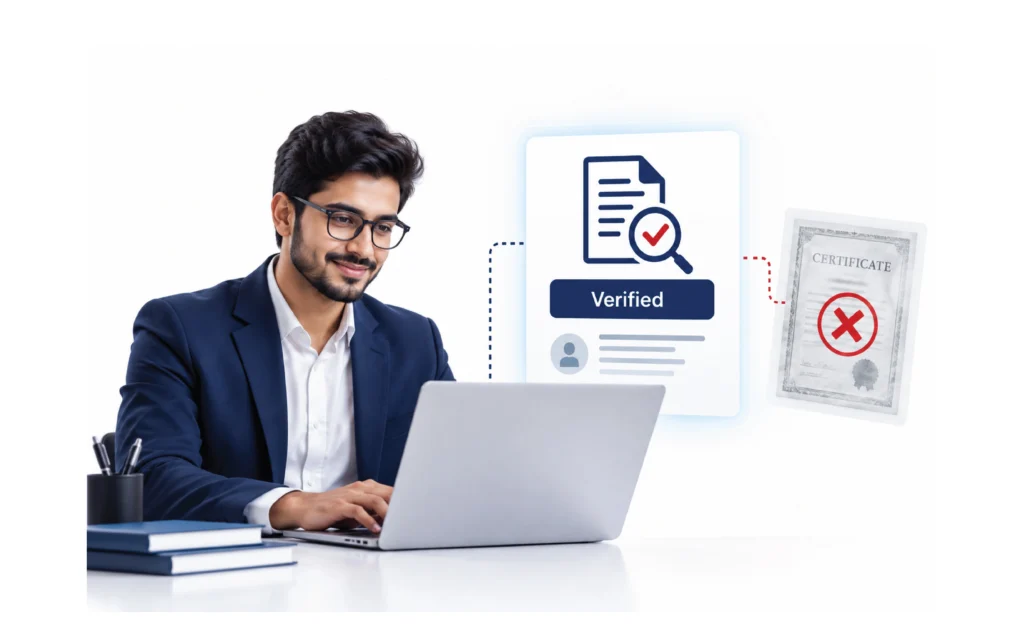
A certificate is meant to provide evidence of achievement. When a credential is falsified, altered, or misrepresented, that evidence breaks down. The consequences can affect employers, education providers, students, and the reputation of the institution that issued the credential. Digital verification does not eliminate every form of fraud, but it changes the question from “Does this certificate look genuine?” to “Can the issuer confirm this credential in its records?”
The scale of this problem is larger than many institutions realize. Recruitment fraud, including everything from identity theft to false qualification claims, is estimated to cost UK businesses £23.9 billion each year. Research commissioned in 2025 found that 67% of large companies have seen an increase in fraudulent job applications, and 45% of those companies uncovered false qualification claims. Yet only 52% of large businesses verify all academic credentials a figure that drops to 37% among medium-sized organisations and just 29% among small businesses. This gap between the scale of the risk and the rate of verification is exactly where a credible online verification system becomes valuable.
Why Credential Fraud Is a Serious Risk
Fake qualifications can create financial, reputational, and operational risks. An employer may make a hiring decision using inaccurate information, potentially placing an unqualified individual into a role with real consequences for safety, compliance, or client trust. An institution may admit a learner based on a false credential, undermining the integrity of its own admissions standards. A genuine student’s qualification may also be unfairly questioned when verification systems are weak, creating friction and doubt for people who have done nothing wrong.
Separate research from the Institute of Student Employers has found that around half of large employers have direct experience with fake degrees, yet only a minority of recruiters properly verify qualifications one survey found that while 82% of employers ask to see a certificate, only 35% actually follow up with the awarding body to confirm it. That gap between requesting evidence and actually checking it is precisely the vulnerability that credential fraud exploits.
Because credentials are increasingly shared digitally, institutions need methods that work beyond the physical document. A well-forged PDF or a manipulated scan can look convincing on screen, and relying on visual inspection alone leaves both employers and institutions exposed.
What Online Verification Changes
An online verification portal provides a direct route to the issuer’s credential record. Instead of relying only on visual features such as stamps, signatures, or paper quality, a verifier can use information such as a certificate number to check whether the credential exists in the issuing system. This shifts the burden of proof away from the physical document itself and onto the institution’s own records a far harder thing to fake convincingly.
The exact security controls vary between systems, so institutions should understand what data is stored, what is displayed, and how access is protected. A verification system is only as trustworthy as the data integrity and access controls behind it, so evaluating those details matters as much as the existence of a verification portal itself.
How a Verification Portal Works
A typical process is straightforward. A certificate is issued with a unique reference. The credential information is stored in the issuing organisation’s system. A student, employer, or authorised third party enters the required details into the verification portal. The system then returns the relevant verification result typically confirming whether the credential exists, and often key details such as the holder’s name, the qualification title, and the date of issue.
UKIQ provides an online certificate verification facility through its website. This gives certificates issued through its process a digital verification point, allowing employers, institutions, or other third parties to confirm a credential’s authenticity without needing to contact the institution directly for a manual check.
The Limits of Verification
Verification confirms what the issuing organisation records. It does not automatically establish that every claim made by a certificate holder is true, nor does it guarantee employment, university admission, or regulatory recognition.
That distinction matters. A good verification system should be presented as a tool for credential integrity, not as a universal guarantee of acceptance. An institution that overstates what its verification portal confirms risks creating the same kind of trust problem that verification is meant to solve if stakeholders believe verification guarantees more than it actually does, a single misunderstanding can undermine confidence in the entire system.
The Institutional Benefits
A verification portal can help institutions protect their reputation by making it easier to confirm legitimate credentials. It can also reduce the time staff spend responding manually to verification requests a meaningful operational benefit given that manual degree checks, phone calls, and email confirmations can consume significant administrative time, particularly for institutions handling a high volume of graduates or certificate holders.
For students, a digital verification pathway can make a credential easier to demonstrate when a third party needs confirmation. Rather than waiting days for an institution to manually confirm a qualification, a graduate can simply direct an employer or partner organisation to a verification portal that returns an immediate, authoritative answer.
There is also a broader institutional integrity benefit. Institutions that make verification easy and transparent send a signal to students, employers, and partner organisations alike that they take the credibility of their credentials seriously. This can be a meaningful differentiator in markets where credential fraud concerns are rising.
Why Digital Credentials Are Becoming More Important
The wider education sector is moving toward digital records, portable credentials, and online verification. Governments, universities, and employers increasingly use digital systems to manage educational information, and the tools used to commit qualification fraud are evolving alongside this shift recent research has specifically pointed to AI tools as a contributing factor in the rise of fraudulent job applications and falsified credentials.
Institutions that build verification into their certification process can therefore be better prepared for a world in which credentials are routinely shared electronically, screened by automated systems, and checked by employers who are increasingly aware of the risks of skipping this step.
What Institutions Should Look For
When evaluating a verification system, institutions should ask several practical questions:
- Do certificates have unique identifiers that can be checked against issuer records?
- Is the verification route easy to access for students, employers, and third parties?
- Is the result tied directly to the issuer’s own records, rather than a static document?
- What information is exposed during verification, and is that appropriate from a privacy standpoint?
- What security and privacy measures protect the underlying data?
The best system is not necessarily the most complicated one. It is one that makes legitimate verification straightforward while protecting the underlying records balancing accessibility for genuine verification requests against the risk of exposing more information than necessary.
Verification as Part of a Broader Integrity Strategy
Online verification is a powerful tool, but it works best as one part of a broader approach to credential integrity. Institutions should also consider clear policies on how certificates are issued and reissued, how lost or disputed credentials are handled, and how staff respond when a verification check reveals a discrepancy.
Communicating the existence of a verification system clearly to students at the point of certification, and to employers or partners who may need to check it later also matters. A verification portal only reduces fraud risk if the people who need to use it actually know it exists.
Protect the Meaning of the Certificate
The purpose of verification is simple: protect the integrity of the credential.
For an institution, that means making it easier to distinguish a genuine achievement from an unsupported claim. UKIQ’s online verification facility is one component of its certification framework and gives stakeholders a way to check issued credentials.
If your institution wants to strengthen credential integrity and provide a clear verification pathway, explore UKIQ’s certification and partnership options.
Frequently Asked Questions
1. Why is certificate fraud a growing concern?
Recruitment fraud costs UK businesses billions annually, and recent research shows a rising share of employers uncovering false qualification claims.
2. How does online verification differ from checking a physical certificate?
It checks the credential directly against the issuer’s records, rather than relying on visual features like stamps or paper quality.
3. Does verification guarantee a job offer or university admission?
No. It confirms the credential’s authenticity in the issuer’s records, not acceptance by any third party.
4. Why do so few employers verify qualifications?
Manual verification is time-consuming, and awareness of fraud risk varies significantly between large and small organisations.
5. What should institutions check before choosing a verification system?
Look for unique certificate identifiers, ease of access, direct ties to issuer records, and strong data privacy protections.
6. Does UKIQ offer certificate verification?
Yes. UKIQ provides an online verification facility, giving certificates issued through its process a digital verification point.