
Streamlining Qualification Audits with Digital Verification Chains

Qualification audits play an important role in maintaining quality, consistency, and accountability across training institutions. They help organisations demonstrate that learners have been properly registered, assessed, graded, and certified, while also providing evidence that appropriate quality assurance processes are being followed.
However, preparing for an audit can become a significant administrative task when records are spread across spreadsheets, emails, paper documents, assessment systems, and certification records. Finding the right information is only one part of the challenge. Compliance teams also need to demonstrate how different records relate to one another.
This is where digital verification chains can provide a more structured approach.
By connecting learner administration, assessment, grading, quality assurance, certification, and credential verification, digital systems can make qualification records easier to manage and review. Rather than preparing evidence only when an audit takes place, institutions can build better recordkeeping into their everyday qualification processes.
For compliance officers, centre administrators, and quality assurance leads, the objective is practical: make qualification audits easier to manage, improve traceability, protect grading integrity, and reduce administrative overhead.
Why Qualification Audits Can Be Time-Consuming and Error-Prone
A qualification audit can involve reviewing evidence from several stages of the learner journey.
Depending on the institution and qualification, quality assurance teams may need to examine learner records, assessment evidence, examination results, grading information, internal verification records, moderation documentation, certification information, and other quality assurance documents.
When these records are managed through disconnected processes, gathering evidence can take considerable time.
An administrator may need to search different folders or systems to locate a learner’s complete record. Assessment information may be stored separately from grading records, while certification requests may be handled through another process.
Manual data entry can create additional administrative pressure. Information may have to be entered repeatedly, records may need to be cross-checked, and staff may spend considerable time locating documents before an audit or quality review.
These challenges can become more noticeable as an institution grows. More learners, qualifications, assessors, examinations, and delivery locations naturally result in more information to manage.
UKIQ’s Centre Management Portal is designed to bring several centre administration activities into a centralised environment. The platform includes learner registration, scheduling, qualification approval, performance monitoring, certification requests, progress tracking, quality assurance documents, reporting, EQA communication, and digital verification.
The purpose of digital infrastructure is therefore not simply to replace paper. It is to make relevant information easier to manage, retrieve, and connect.
What Is a Digital Verification Chain?
A digital verification chain is a connected process that links important stages of a qualification lifecycle.
Instead of treating registration, assessment, grading, quality assurance, certification, and verification as completely separate activities, digital systems can connect the information generated throughout these stages.
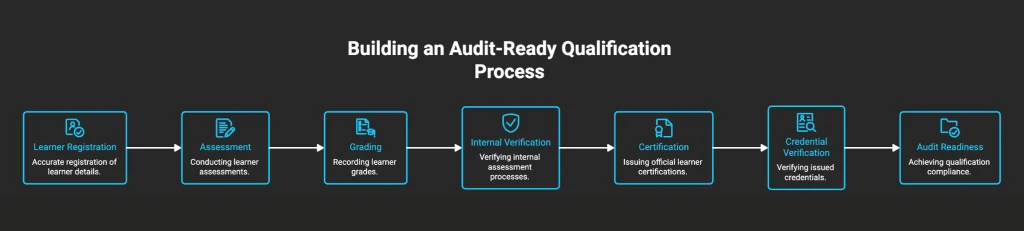
A qualification process may involve learner registration, assessment, grading, internal verification, certification, and subsequent credential verification.
The value of this approach is traceability.
For example, an institution may need to establish who was registered for a qualification, which assessment was completed, what result was recorded, whether the assessment outcome was reviewed, when certification was requested, and how the resulting credential can be verified.
A connected digital environment can make these records easier to manage and review.
UKIQ describes its digital platforms as supporting the learner journey from registration through assessment and certification. Its digital solutions are designed to integrate administration, online examinations, assessment systems, and digital certificate verification.
This makes digital verification chains particularly relevant to qualification audits because they help bring different stages of qualification delivery into a more organised digital workflow.
The objective is not to eliminate professional judgement. Assessors, centre staff, internal verifiers, and quality assurance professionals still have important responsibilities. Digital systems provide the infrastructure for recording and managing the evidence associated with those responsibilities.
How a Digital Verification Chain Works
A digital verification chain can support different stages of qualification management.
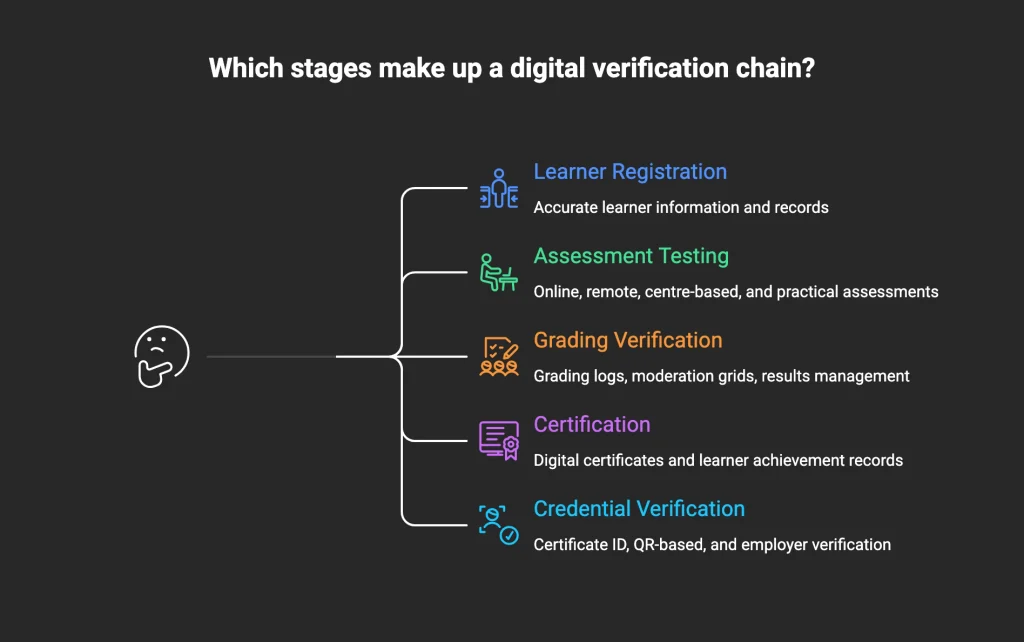
Learner Registration
The process begins with accurate learner information.
Centres need to maintain appropriate records about learners, their programmes, modules, and progression.
UKIQ’s Centre Management Portal supports both batch and direct learner registration, allowing approved centres to manage learner information within a central administration platform.
Centralised registration can reduce repetitive administration and make it easier to maintain consistent learner records.
Assessment and Testing
The next stage is assessment.
Depending on the qualification, learners may complete online examinations, remote assessments, centre-based examinations, practical assessments, assignments, or portfolios.
UKIQ’s Examination & Assessment Solutions include online examinations, remote assessments, centre-based examinations, practical assessments, assignments and portfolios. The platform also includes candidate verification, internal verification, results management, and qualification tracking.
This means assessment information can become part of the wider qualification record rather than remaining an isolated activity.
Grading and Internal Verification
Once an assessment has been completed, results need to be evaluated and managed appropriately.
UKIQ’s assessment solutions include internal verification, grading logs, moderation grids, and results management. These functions support the processes used by institutions to manage assessment outcomes and maintain consistency.
Digital records can make it easier for quality assurance teams to review the relevant information associated with assessment and grading.
Certification
Following successful completion of the required learning and assessment processes, certification provides formal evidence of achievement.
UKIQ’s Digital Certification Platform supports digital certificates and learner achievement records, including information relating to completed modules, grades, and award credits.
Credential Verification
The final stage involves confirming the credential.
UKIQ’s Digital Certification Platform includes a public-facing verification portal where third parties can enter a certificate ID to verify authenticity. It also supports QR-based verification and employer verification services.
Together, these capabilities create a more connected digital environment for managing qualification information.
How Digital Credentials Support Grading Integrity and Traceability
Grading integrity depends on more than the final certificate.
It is influenced by how assessments are conducted, how results are recorded, how grading is managed, and how internal quality assurance procedures are applied.
For quality assurance teams, useful records may include assessment results, grading information, moderation records, internal verification evidence, and certification information.
Keeping these records within structured digital systems can make it easier to review the relationship between assessment outcomes and qualification awards.
UKIQ’s Examination & Assessment Solutions specifically include internal verification, grading logs, moderation grids, results management, and qualification tracking.
This can support a more traceable qualification process.
Digital credentials provide another layer of accessibility and verification. UKIQ’s Digital Certification Platform includes learner achievement records that map completed modules, grades, and award credits.
Digital verification can also help organisations confirm credential information without relying entirely on manual correspondence.
Importantly, digital systems do not replace academic or professional judgement. Assessors and quality assurance teams remain responsible for applying the relevant assessment and verification procedures.
The role of technology is to provide a structured environment in which those activities can be recorded, managed, and accessed more efficiently.
Reducing Administrative Overhead Through Automated Verification
One of the most practical benefits of digital qualification systems is the potential to reduce administrative overhead.
Consider a certificate verification request handled through a traditional manual process. An administrator may need to locate the learner record, find the relevant qualification information, check the certificate details, confirm the information, and respond to the organisation making the request.
When verification requests are frequent, these individual tasks can consume significant administrative time.
Digital verification can simplify this process.
UKIQ’s Digital Certification Platform provides a public verification portal where third parties can enter a certificate ID and verify its authenticity. QR verification is also available on printed certificates.
The Centre Management Portal also supports automated processes such as batch learner registration and verification requests. UKIQ states that the platform is designed to reduce paperwork, streamline administration, and support continuous data archiving and reporting for external quality assurance.
These capabilities can reduce repetitive tasks associated with:
- Searching for records
- Re-entering information
- Managing paper documentation
- Responding to individual verification requests
- Preparing evidence for reviews
- Maintaining separate administrative records
The benefit is not that every compliance activity becomes automated. Rather, routine processes can be handled more efficiently, allowing staff to focus on tasks that require professional judgement and quality oversight.
The Role of Centre Management Infrastructure in Supporting Smooth Audits
A digital verification system works best when it is supported by appropriate administrative infrastructure.
If learner information is held in one system, assessment records in another, quality assurance documents in paper files, and certification requests through email, staff may still face difficulties when they need to assemble evidence.
This is why center management infrastructure plays an important role in supporting audit preparation.
UKIQ’s Centre Management Portal acts as a central administration platform for approved centres and recognised providers. It includes learner registration, booking and scheduling, qualification approval, performance monitoring, certification requests, progress tracking, quality assurance documents, reporting, EQA communication, and digital verification.
This centralised approach can provide greater visibility across centre operations.
For example, administrators can manage learner registration and progression while also maintaining relevant quality assurance documentation and certification information.
UKIQ also states that its portal supports external quality assurance readiness through continuous data archiving and reports.
This is particularly useful because audit readiness should not begin only when an audit date is announced. Maintaining organised records as part of routine centre management can make future reviews easier to prepare for.
How Online Testing Procedures Support Audit Readiness
Audit readiness begins during the assessment process.
Assessment evidence can form an important part of the information used to demonstrate that learners have achieved the required learning outcomes.
UKIQ’s examination and assessment systems support online examinations, remote assessments, centre-based examinations, practical assessments, assignments, portfolios, candidate verification, internal verification, results management, and qualification tracking.
Its Assessment Hub also supports online and blended assessments, remote invigilation, assignment submission, assessment scheduling, candidate authentication, assessment security, and performance analytics.
This means online testing procedures can contribute to the wider evidence trail surrounding a qualification.
For example, a digital assessment can generate information that supports subsequent grading and results management. Internal verification and moderation processes can then provide additional quality assurance before certification.
The important point is that online assessment should not be viewed simply as a convenient way to conduct an examination.
For audit purposes, it is also important to consider how assessment information is recorded, managed, reviewed, and connected to the wider qualification process.
This helps make audit readiness part of assessment management rather than an activity that begins only after assessment has finished.
Digital Certification and Certificate Verification
Certification is the stage at which a learner’s achievement becomes an official credential.
Traditional certificate verification can require employers, institutions, or other stakeholders to contact the issuing organisation and request confirmation.
Digital certification provides a more efficient approach to this process.
UKIQ’s Digital Certification Platform provides digital certificates, learner achievement records, a public verification portal, employer verification services, QR verification, and secure credential storage.
The platform also describes encrypted validation records and cryptographic validation parameters designed to protect credential records against alteration.
This gives digital credentials a role beyond simply replacing a paper certificate.
They can provide a convenient way to present achievement information while also giving authorised third parties a mechanism to check credential authenticity.
With the appropriate verification system, employers and other stakeholders can verify certificates directly instead of relying entirely on phone calls, written requests, or email correspondence.
UKIQ’s qualifications page also states that certifications carry a unique digital identifier that can be verified through its secure registry network.
Building an Audit-Ready Qualification Process
A practical digital approach to qualification management involves maintaining evidence throughout the learner lifecycle.
It begins with accurate learner registration and continues through assessment, grading, internal verification, certification, and credential verification.
For each stage, institutions should consider what information needs to be recorded, who is responsible for it, how it will be reviewed, and how it can be retrieved when required.
A well-organised digital process can help ensure that assessment records are not isolated from learner information, grading records are not separated from the relevant assessment activity, and certification information can be checked against the appropriate qualification record.
This approach changes audit preparation from a largely reactive activity into an ongoing administrative process.
Instead of assembling records from multiple sources immediately before an audit, institutions can maintain relevant evidence continuously.
The result is a more organised approach to qualification compliance and audit readiness.
Practical Benefits for Compliance and Quality Assurance Teams
For compliance officers, digital verification chains can make qualification information easier to organise and retrieve.
For centre administrators, centralised systems can reduce repetitive registration, documentation, certification, and verification tasks.
For quality assurance leads, connected assessment and grading information can provide better visibility into the qualification process.
For training institutions, digital infrastructure can support consistent administration as learner numbers and programme offerings expand.
For learners and employers, digital credentials and verification systems can make qualification checking more convenient.
UKIQ’s digital solutions are designed around this broader ecosystem. The organisation describes its platforms as supporting end-to-end qualification delivery, secure assessment, digital certificate verification, quality assurance, and compliance.
The overall value comes from connecting these functions rather than treating each digital tool as an isolated solution.
Simplify Your Qualification Audits with Digital Verification
Qualification audits require more than a final certificate. They require evidence that learners have been properly registered, assessed, graded, verified, and certified.
When that evidence is scattered across paper files, spreadsheets, emails, and disconnected systems, preparing for an audit can become unnecessarily difficult.
Digital verification chains provide a more connected approach.
By linking learner administration, assessment, grading, quality assurance, certification, and credential verification, training institutions can improve traceability while helping to reduce administrative overhead.
UKIQ‘s digital ecosystem brings together centre management, examination and assessment solutions, assessment technology, digital certification, and verification tools to support different stages of qualification delivery.
For organisations focused on compliance and quality assurance, the objective is straightforward: make reliable qualification records part of everyday operations rather than something that has to be reconstructed when an audit arrives.
Simplify your qualification audits with digital verification. Contact UKIQ.