
Leveraging Real-Time Performance Monitoring for Data-Driven Decisions

Training decisions are only as effective as the information behind them. When administrators and learning leaders rely mainly on end-of-course reports, spreadsheets or periodic reviews, important changes in learner performance can remain hidden until it is too late to respond.
A learner may begin falling behind, struggle with a particular assessment area or lose momentum during a programme, but a retrospective report may only reveal the issue after the course has finished. For training centres and organisations managing multiple learners, programmes and assessment stages, this can make effective intervention more difficult.
Real-time progress monitoring offers a more responsive approach. Instead of viewing learner performance only at selected reporting points, institutions can use continuously available information to understand progression, assessment activity and areas that require attention. UKIQ‘s digital ecosystem includes tools designed to support learner administration, assessment delivery, progress tracking, reporting and digital certification, giving approved centres and training providers a more connected approach to programme delivery.
Why Real-Time Progress Monitoring Matters
Traditional training reports are useful, but they often provide a snapshot of what has already happened. By the time a monthly or end-of-programme report is reviewed, an administrator may already be dealing with missed assessments, incomplete modules or learners who need additional support.
Real-time monitoring changes the timing of that decision-making process. Rather than waiting for a final outcome, administrators can review available progress information while training is still underway. This creates an opportunity to identify issues earlier and consider appropriate action.
For example, if a group of learners is progressing normally through a programme but several candidates have not completed a particular unit, the information can prompt a closer review. The issue may relate to the complexity of the learning material, assessment requirements, scheduling or access to support. The important point is that the organisation has an opportunity to investigate while the programme is active.
This approach is particularly relevant to training providers and approved centres that manage multiple candidates and qualification pathways. UKIQ‘s Centre Management Portal is designed to centralise programme delivery and learner administration, with features for registrations, scheduling, performance monitoring, progress tracking, reports and quality assurance documentation.
The value of real-time data is therefore not simply the speed at which information appears. Its value comes from making useful information available when there is still time to act on it.
How Advanced Tracking Portals Support Continuous Learner Monitoring
An effective monitoring system needs more than a collection of isolated records. Administrators need a practical way to understand where learners are within a programme and what has already been completed.
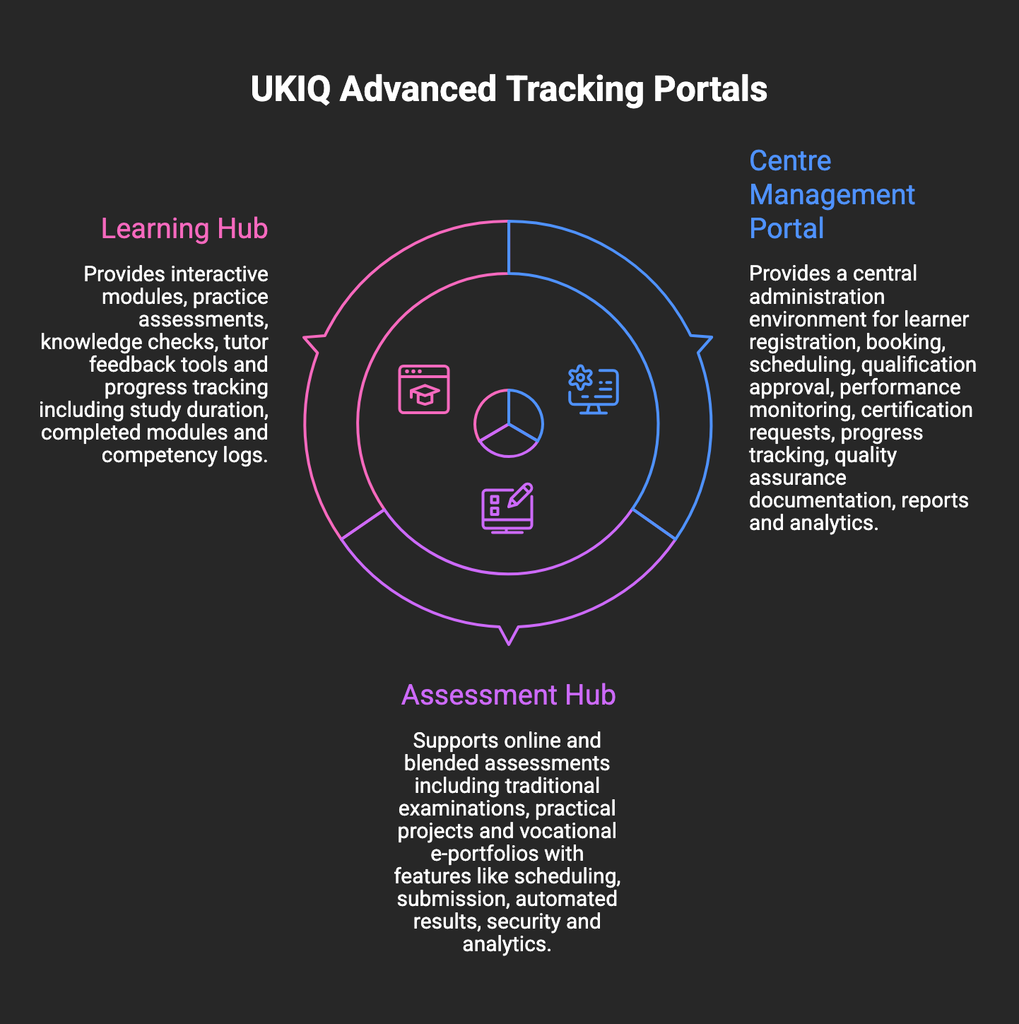
UKIQ’s Centre Management Portal provides a central administration environment for approved centres and recognised providers. According to UKIQ, the portal supports learner registration, booking and scheduling, qualification approval, performance monitoring, certification requests, progress tracking, quality assurance documentation, reports and analytics. It also allows centres to monitor candidate learning tracks and unit completion in real time.
This creates a stronger foundation for administrative tracking tools than disconnected spreadsheets or manually maintained records. When programme information is managed through a central platform, administrators can spend less time locating information and more time interpreting it.
The monitoring process can also extend into assessment. UKIQ’s Assessment Hub supports online and blended assessments, including traditional examinations, practical projects and vocational e-portfolios. Its listed features include assessment scheduling, assignment submission, automated results, assessment security and performance analytics.
Learner activity can also be supported through the UKIQ Learning Hub. The platform provides interactive modules, practice assessments, knowledge checks, tutor feedback tools and progress tracking that includes study duration, completed modules and competency logs.
Together, these capabilities demonstrate why advanced tracking portals should be considered part of a wider training infrastructure rather than simply another reporting tool.
Turning Performance Analytics Reports into Actionable Decisions
Collecting data is only the first step. The real value of performance analytics comes from using the information to support better decisions.
A useful monitoring process begins by identifying the information that matters. Depending on the programme, this may include module completion, assessment performance, learning activity, progress through units or patterns in candidate results. Once these indicators are available, administrators and learning leaders can look for patterns rather than focusing on individual data points.
For example, a single low assessment result does not necessarily indicate a wider problem. However, if several learners experience difficulty in the same assessment area, that pattern may justify reviewing the relevant learning content, assessment instructions or delivery approach.
Similarly, progress data can help administrators understand whether learners are moving through a programme consistently. A significant difference between expected and actual progress may indicate that additional communication or academic support should be considered.
UKIQ’s Centre Management Portal includes performance monitoring and reports and analytics, while the Assessment Hub provides performance analytics covering areas such as response times, question difficulty indicators and cohort comparisons.
This creates the possibility of moving from simple reporting to data-driven decision making. Instead of asking only, “What happened?”, learning teams can also ask, “What does the available information suggest we should examine next?”
Using Data for Targeted Learner Support
One of the most practical applications of learner monitoring is identifying where support may be required.
Not every learner needs the same type of intervention. Some may need additional learning resources, while others may benefit from clarification, further practice or more direct tutor feedback. Monitoring can help organisations identify where attention may be appropriate without treating every learner in the same way.
Consider a learner who has completed several modules successfully but repeatedly struggles with a particular knowledge check. Rather than waiting for a final examination result, the training team can review the learner’s progress and consider additional practice or guidance.
UKIQ’s Learning Hub supports this type of learning environment through interactive modules, digital libraries, practice assessments, knowledge checks and tutor feedback tools. It also provides progress tracking for study duration, completed modules and competency logs.
The same principle can be applied at cohort level. If multiple candidates show difficulty in the same area, the response may involve reviewing learning materials or delivery methods rather than providing individual support to every learner.
This creates a practical cycle of monitoring, reviewing, supporting and reassessing. The purpose is not to monitor learners for the sake of monitoring them. It is to make information available so that appropriate support can be considered earlier.
For training institutions, this can also contribute to better learner engagement and programme completion. UKIQ describes its Learning Hub as being designed to support learner success and programme completion, with flexible access to digital learning resources and progress tracking.
From Learner Data to Strategic Training Decisions
Real-time learner information becomes even more valuable when it is connected to wider organisational objectives.
For L&D leaders, the question is not simply whether employees or learners have completed training. The larger question is whether learning activity is supporting the capabilities the organisation needs.
This is where strategic training alignment becomes important. UKIQ’s L&D Strategy service is focused on aligning workforce development initiatives with business priorities and future growth objectives. Its approach includes learning needs analysis, capability reviews, learning frameworks, learning pathways, digital strategies and effectiveness evaluation.
Performance information can provide useful evidence within that broader planning process. If a capability review identifies a particular skills requirement, learner progress and assessment information can help organisations understand how existing training is addressing that requirement.
For example, an organisation investing in professional development may want to monitor whether learners are progressing through the relevant learning pathways and completing assessments successfully. Over time, this information can contribute to reviews of programme effectiveness and future learning priorities.
The objective is not to reduce L&D to numbers. Data should support professional judgement, not replace it. Experienced trainers and L&D leaders still need to consider learner circumstances, programme context and organisational priorities.
Used appropriately, however, performance information can provide a stronger evidence base for those decisions.
Practical Examples of Data-Driven Training Interventions
Real-time performance monitoring can support a range of practical interventions.
Identifying stalled progress
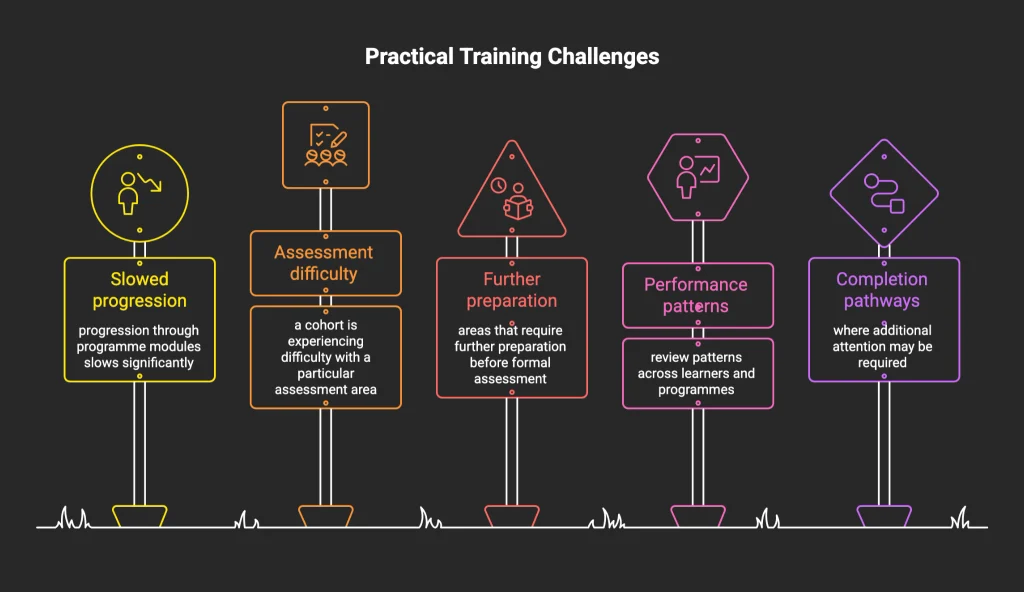
If a learner’s progression through programme modules slows significantly, administrators can review the available information and determine whether communication or additional support is appropriate.
Responding to assessment patterns
If performance analytics show that a cohort is experiencing difficulty with a particular assessment area, the training provider can review the corresponding learning materials, delivery approach or assessment preparation.
Supporting examination readiness
Practice assessments and knowledge checks can provide learners with opportunities to identify areas that require further preparation before formal assessment. UKIQ’s Learning Hub includes practice assessments and modular knowledge checks designed to support learning and examination preparation.
Monitoring programme performance
Centre administrators can use available performance and reporting information to review patterns across learners and programmes. UKIQ’s Centre Management Portal specifically includes performance monitoring, reports and analytics, and progress tracking capabilities.
Reviewing learner completion
Progress information can help training teams identify whether learners are moving through their expected learning pathways and where additional attention may be required.
These examples illustrate an important principle: data becomes useful when it leads to a relevant action.
Building a More Connected Training Management Environment
Real-time monitoring works best when the underlying systems are connected.
If learner registrations are stored in one system, assessment information in another and certification records somewhere else, administrators may still need to reconcile information manually. A connected digital environment can reduce this fragmentation.
UKIQ’s digital ecosystem brings together the Centre Management Portal, Assessment Hub, Learning Hub, Examination and Assessment Solutions and Digital Certification Platform. The organisation describes these platforms as supporting approved centres, training providers, educational institutions, employers and learners in qualification delivery.
The Centre Management Portal provides the administrative foundation, while the Assessment Hub supports online and blended assessment delivery. The Learning Hub provides digital learning and progress tracking, and the Digital Certification Platform supports secure digital certificates and credential verification.
This connected approach can help organisations maintain greater visibility across the learner journey, from programme administration and learning activity through assessment and certification.
It can also support quality assurance. UKIQ’s Centre Management Portal includes quality assurance documentation, external audit logs, verification reports and assessment templates, while its L&D Strategy service includes quality reviews, assessment strategies, IQA systems and recognition readiness.
Real-Time Monitoring Should Support Better Decisions, Not More Reporting
The purpose of real-time performance monitoring is not to create more dashboards or increase the amount of information administrators have to process.
A successful approach focuses on relevant information and clear decision-making processes. Training teams should establish which indicators matter, who is responsible for reviewing them and what actions may follow when a significant change is identified.
It is equally important to use learner information responsibly. Monitoring should support learning, quality improvement and programme management rather than becoming an exercise in unnecessary surveillance.
When data is connected to meaningful learning objectives, it can help institutions move from reactive reporting towards continuous improvement.
For training centres, this means being able to understand learner progress while programmes are still active. For L&D leaders, it means having stronger evidence to inform workforce development planning. For administrators, it means spending less time assembling fragmented information and more time using it.
Turn Learner Data Into Smarter Training Decisions
Real-time progress monitoring can give training organisations greater visibility into learner progression, assessment activity and programme performance. When supported by appropriate digital infrastructure, that information can contribute to earlier intervention, more informed programme reviews and stronger alignment between learning activity and organisational objectives.
UKIQ’s digital platforms provide tools across learner administration, assessment, learning, progress tracking, reporting and digital certification. Its L&D Strategy service also connects learning frameworks with workforce development priorities and effectiveness evaluation.
For organisations looking to make better use of learner information, the next step is to turn monitoring into action.
Turn learner data into smarter training decisions. Contact UKIQ