
Mapping Your Curriculum to UKIQ’s 6-Level Qualifications Framework
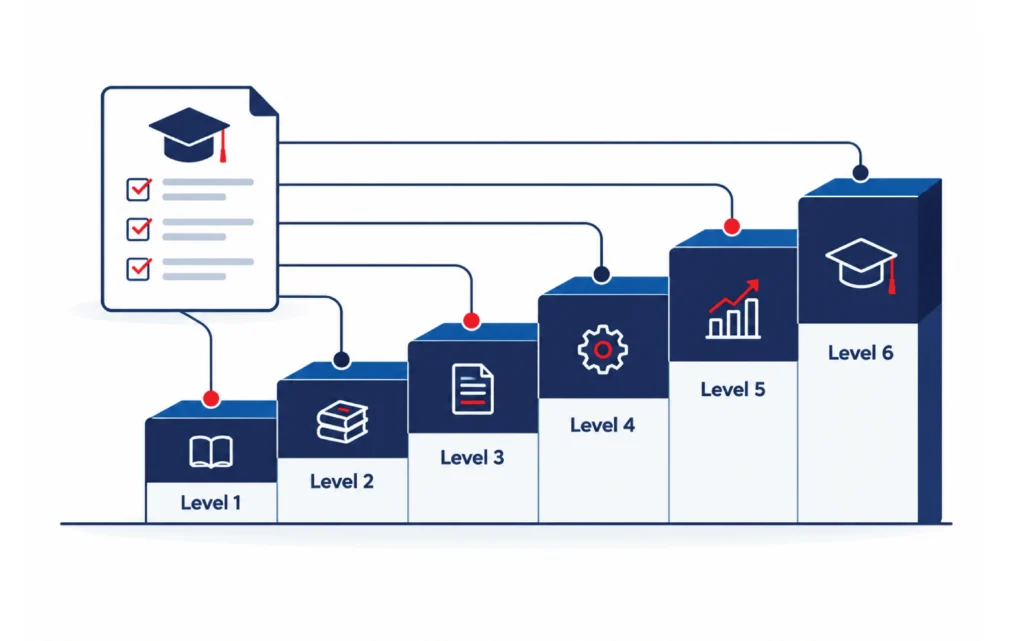
Mapping your curriculum to the appropriate qualification level is an important part of preparing a programme for quality review. It helps training providers explain what learners are expected to know, understand and do by the end of a course, how demanding the learning is, and whether assessments provide suitable evidence of achievement.
For providers preparing a programme for review by UK International Qualifications (UKIQ), curriculum mapping offers a structured way to present this information. Rather than choosing a level based only on a course title, its duration or the qualifications of its learners, providers should examine the curriculum’s learning outcomes, content, assessment methods and expected level of responsibility.
UKIQ describes its six-level framework as a tool for reviewing the expected complexity, depth of learning, practical application and professional responsibility associated with submitted programmes. The levels support UKIQ’s programme review and classification process; they should not be treated as automatic equivalents to regulated UK qualifications.
A clear mapping process can help curriculum designers identify gaps, strengthen learning outcomes and prepare more consistent documentation for review. The following five steps provide a practical approach.
Understanding UKIQ’s Six Programme Review Levels
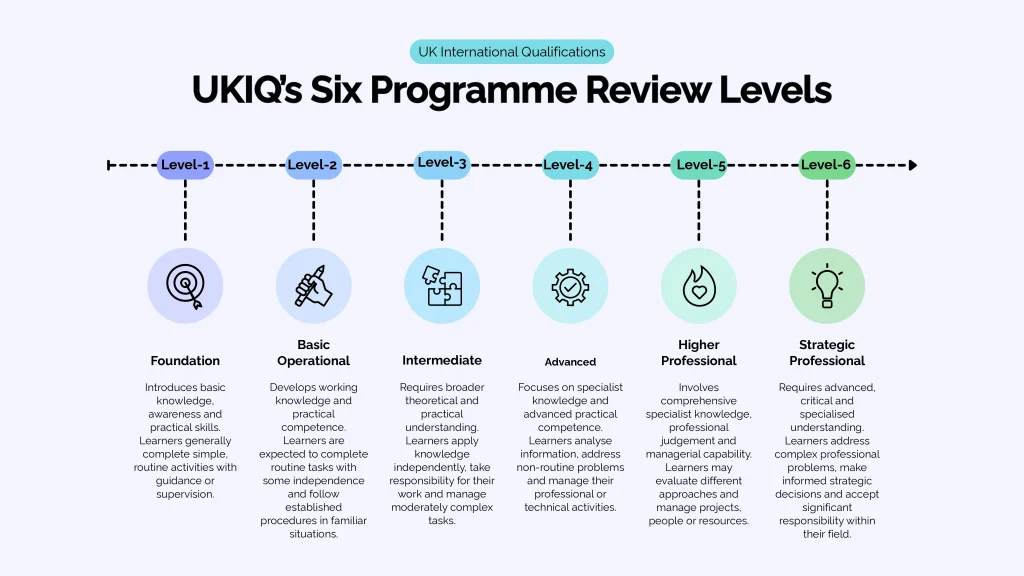
Before mapping a curriculum, providers should understand the progression represented by UKIQ’s published level descriptions. Each level reflects different expectations for knowledge, practical competence, independence, problem-solving and responsibility.
Level 1 – Foundation introduces basic knowledge, awareness and practical skills. Learners generally complete simple, routine activities with guidance or supervision.
Level 2 – Basic Operational develops working knowledge and practical competence. Learners are expected to complete routine tasks with some independence and follow established procedures in familiar situations.
Level 3 – Intermediate requires broader theoretical and practical understanding. Learners apply knowledge independently, take responsibility for their work and manage moderately complex tasks.
Level 4 – Advanced focuses on specialist knowledge and advanced practical competence. Learners analyse information, address non-routine problems and manage their professional or technical activities.
Level 5 – Higher Professional involves comprehensive specialist knowledge, professional judgement and managerial capability. Learners may evaluate different approaches and manage projects, people or resources.
Level 6 – Graduate or Strategic Professional requires advanced, critical and specialised understanding. Learners address complex professional problems, make informed strategic decisions and accept significant responsibility within their field.
These descriptions should be used as reference points, not as a checklist in which one sophisticated verb automatically determines a level. A curriculum may include activities with different degrees of difficulty. The overall level proposal should therefore be supported by the programme’s intended outcomes, learning content, assessment demands and expectations of learner independence.
Providers should also distinguish UKIQ’s framework from other qualification frameworks. Similar level numbers do not automatically mean that two frameworks describe equivalent qualifications. UKIQ’s published clarification states that its programme review levels do not, by themselves, confirm that a programme is regulated in the UK or directly equivalent to a GCSE, A Level, diploma or university degree.
A Five-Step Method for Curriculum Mapping
Step 1: Audit the Existing Curriculum
Start by gathering the current curriculum documents. These may include the programme specification, module descriptions, syllabus, learning outcomes, lesson plans, assessment briefs, marking criteria and learner guidance.
Review these materials together rather than examining the syllabus in isolation. A syllabus shows what is taught, but it may not fully explain what learners must demonstrate or how their achievement is assessed.
Create a simple inventory of the modules and record the purpose of each one. Identify the knowledge, practical skills and professional behaviours that learners are expected to develop. Note any prerequisites, opportunities for independent work and progression between modules.
Next, identify gaps or inconsistencies. For example, a module may promise that learners will develop strategic decision-making skills, while its lessons focus mainly on definitions and its assessment consists only of a short recall quiz. This creates a mismatch between the stated outcome and the evidence collected.
The audit should establish what the programme currently delivers, what learners are expected to achieve and where the documentation needs improvement. Avoid assigning a UKIQ level at this stage. First establish an accurate picture of the curriculum.
Step 2: Write Measurable Learning Outcomes
Learning outcomes describe what learners should be able to demonstrate after completing a module or programme. They provide the foundation for comparing curriculum expectations with UKIQ’s level descriptions.
Outcomes should use clear, observable actions. Words such as understand, know and appreciate can be difficult to assess when they are not supported by a specific demonstration of learning.
For example, “Understanding search engine optimization” does not explain what a learner must do to demonstrate achievement. A more measurable outcome would be: “Conduct a basic SEO audit using a supplied checklist and identify common on-page issues.”
For a more advanced programme, an outcome might require learners to analyse competing SEO strategies, justify recommendations using performance data and evaluate the likely business impact. The distinction lies not simply in the verb used, but in the depth of analysis, the complexity of the task, the evidence required and the degree of independence expected.
When reviewing each outcome, ask:
- What must the learner demonstrate?
- What knowledge or skill is required?
- How complex is the task or problem?
- How much guidance is provided?
- What evidence will show that the outcome has been achieved?
Check that each outcome is assessable and relevant to the programme’s purpose. Remove duplication and make sure that important outcomes are not missing from the teaching plan or assessment strategy.
Step 3: Compare Outcomes with UKIQ’s Level Descriptions
Once outcomes are measurable, compare them with the six UKIQ programme review levels. Examine the full demand of each outcome instead of matching individual words.
Consider four areas: knowledge and understanding, practical application, problem-solving and responsibility. These areas help curriculum designers explain how the programme’s expectations relate to the published descriptions.
For example, a learner who follows a supplied checklist to complete a routine task with supervision demonstrates a different level of independence from a learner who selects an appropriate method, analyses unexpected findings and justifies a solution without step-by-step direction.
Similarly, producing a report from a template is not necessarily equivalent to evaluating several approaches and defending a recommendation against defined criteria. The expected reasoning, complexity and evidence matter.
Create a mapping table with one row for each learning outcome. Record the outcome, the relevant UKIQ level description, the expected evidence and the rationale for the proposed alignment. Where an outcome appears to sit between levels, document why and review whether the outcome is too broad, combines several demands or needs clearer wording.
Do not assume that every module must be identical in difficulty. Some modules may introduce foundational knowledge before learners apply it in more demanding situations. However, the programme’s overall level proposal should be coherent and supported by the learning and assessment requirements across the curriculum.
This comparison is an internal planning exercise, not a guarantee of the level UKIQ will assign. The final classification remains subject to the applicable UKIQ review process.
Step 4: Document Guided Learning Hours and Total Qualification Time
Curriculum mapping should explain not only what learners are expected to achieve but also how the programme is delivered and how much learning time is planned.
Guided Learning Hours (GLH) generally refer to time spent learning under the immediate guidance or supervision of a tutor, trainer or other appropriate person. Total Qualification Time (TQT), in Ofqual’s framework, estimates the total time a typical learner might reasonably need to achieve the qualification’s required outcomes. It includes guided learning as well as relevant independent study and assessment activity.
These definitions are useful when documenting programme delivery, but Ofqual’s requirements for regulated qualifications should not automatically be treated as UKIQ-specific rules. Providers should confirm the documentation and time-recording requirements that apply to their own UKIQ submission.
Prepare a realistic breakdown of planned activities. Depending on the course design, this might include tutor-led sessions, supervised practical work, independent research, coursework, project development and assessment preparation. Clearly distinguish guided activities from independent work, and avoid counting the same activity twice.
For example, a fictional digital marketing programme might include tutor-led sessions on SEO, supervised campaign exercises, independent competitor research and a final strategy project. The provider should explain how the planned time supports the learning outcomes and assessment requirements.
Do not use the total number of hours to determine the programme’s level by itself. A longer course is not automatically more advanced, and a shorter course is not automatically foundational. Duration, level and award type are different considerations. Likewise, do not assume that a particular number of hours automatically qualifies a programme as a certificate or diploma.
Step 5: Align Assessment with the Learning Outcomes
Assessment provides evidence of whether learners have achieved the intended outcomes. It should test the knowledge, skills and level of performance stated in the curriculum.
Map each outcome to at least one appropriate assessment method. Depending on the programme, evidence might include practical demonstrations, written assignments, case studies, projects, presentations, portfolios or observed workplace tasks.
Check that the assessment requires the learner to demonstrate the expected level of demand. If the outcome requires learners to evaluate options and justify a decision, an assessment that only asks them to define terms may not be sufficient. The task and marking criteria should allow the learner to demonstrate evaluation and justification.
Review the assessment criteria as carefully as the assessment task itself. Criteria should explain what acceptable performance looks like and how the assessor will judge the evidence. Where independent judgement or complex problem-solving is an intended outcome, the criteria should address those elements explicitly.
Also consider consistency. Different assessors should be able to interpret the criteria in a similar way, and learners should receive clear instructions about the evidence they need to submit.
Finally, check the alignment across the entire programme: learning outcomes should connect to teaching activities, assessment tasks and marking criteria. Record any changes needed before submitting the curriculum for review.
Worked Example: Mapping a Digital Marketing Strategy Programme
Consider a fictional programme titled Professional Certificate in Digital Marketing Strategy. The example below demonstrates the mapping process; it does not represent an actual UKIQ-approved programme or establish a recommended UKIQ level.
The proposed curriculum contains three areas: conducting an SEO audit, evaluating paid advertising campaign performance and preparing a digital marketing strategy. The provider has planned tutor-led sessions, supervised exercises, independent research and a final presentation.
The first step is to audit the module documents and confirm what each activity is intended to teach. The provider then rewrites broad outcomes into measurable statements, such as “Identify common technical and on-page SEO issues using audit evidence” and “Compare campaign performance data and justify recommended optimisation actions.”
The curriculum designer compares these outcomes with UKIQ’s published descriptions. Routine tasks completed with guidance may align more closely with the expectations described at a lower level, while independent analysis, non-routine problem-solving or strategic decision-making may indicate more demanding outcomes. The designer must consider the full task and the expected performance rather than rely on the word “strategy” in the course title.
Next, the provider documents the learning-time plan. Suppose the initial estimate is 30 guided hours and 30 hours of independent study and assessment activity. The resulting estimate is 60 hours in total, provided the activities are appropriately classified and not double-counted. This calculation describes the proposed learning time; it does not establish the programme’s level or award category.
The final step is to review the assessment. Learners might submit an SEO audit, explain campaign optimisation decisions using supplied data and present a strategy supported by evidence. The provider checks that the assessment criteria match the expected outcomes and that learners have sufficient opportunities to demonstrate the required skills.
The mapping table could contain the following columns:
| Learning outcome | Evidence required | Expected demand | Mapping rationale |
| Identify common SEO issues | Completed audit and issue log | Depends on task complexity and guidance | Explain the expected scope of the audit |
| Evaluate campaign performance | Data analysis and justified recommendations | Requires analysis and reasoned judgement | Show the evidence and independence expected |
| Develop a marketing strategy | Strategy document and presentation | Depends on complexity, alternatives considered and responsibility | Explain why the task matches the proposed level description |
The provider should then review the programme as a whole, resolve inconsistencies and confirm the applicable submission requirements with UKIQ. A level should not be assigned simply because the programme is called a certificate, includes strategic content or has a total of 60 hours.
Common Curriculum Mapping Mistakes to Avoid
One common mistake is choosing a level based on the course title. Terms such as professional, advanced and strategic may sound demanding, but they do not prove the complexity of the learning outcomes or assessment.
Another is treating learning-outcome verbs as automatic level indicators. A verb such as analyse may describe a relatively simple task or a highly complex one. The context, evidence, degree of independence and expected quality of judgement must also be considered.
Providers should avoid assuming that UKIQ’s level numbers are equivalent to similarly numbered levels in the Regulated Qualifications Framework (RQF), the Framework for Higher Education Qualifications (FHEQ), the Scottish Credit and Qualifications Framework (SCQF) or the European Qualifications Framework (EQF). These frameworks have their own purposes and structures. Any claim of formal equivalence requires appropriate evidence and authority.
A further mistake is treating learning hours as proof of level. GLH and TQT help describe programme size and planned learner effort, but they do not independently establish the depth of learning or the level at which outcomes are achieved.
Finally, do not leave the mapping rationale undocumented. A table that simply places a level beside each module offers limited explanation. Strong documentation shows how the outcomes, teaching, assessment evidence and expected learner performance support the proposed classification.
Preparing Your Curriculum for UKIQ Review
A well-mapped curriculum gives reviewers a clearer view of the programme’s purpose, learning outcomes, delivery plan and assessment approach. It also helps providers identify weaknesses before submission and maintain more consistent academic documentation.
Before proceeding, check that the curriculum is complete, outcomes are measurable, assessment criteria match the intended learning, and guided and independent learning time has been recorded transparently. Keep the mapping rationale alongside the relevant programme documents so that proposed changes can be traced and reviewed.
UKIQ’s published information explains its six-level review framework and the documentation that may be relevant to programme and institutional review. Providers should contact UKIQ directly to confirm the current requirements, submission process and any applicable mapping template before finalising a programme.
Prepare your curriculum with clear outcomes, evidence-based assessments and a documented rationale for its proposed level. Contact UKIQ to discuss the programme review requirements relevant to your training provision.