
Demystifying UK Educational Terminology: What ‘UK-Based,’ ‘UK-Registered,’ ‘Accredited,’ and ‘Regulated’ Actually Mean

When comparing education and training providers, terms such as “UK-based”, “UK-registered”, “accredited” and “regulated” can sound similar. However, each describes something different. Understanding the difference between UK accredited vs regulated education can help learners choose courses more carefully and training providers communicate their credentials accurately.
A provider may operate from the United Kingdom without offering regulated qualifications. An organisation may be registered with a UK database without receiving educational accreditation. Similarly, an accredited course is not automatically a qualification regulated by a UK qualifications regulator.
The key is to identify exactly what a claim refers to, who has granted the status and whether it can be independently verified.
Why UK Educational Terminology Matters
Educational terminology can influence how learners understand a course, certificate or training institution. For providers, using these terms accurately helps establish transparent expectations and reduces the risk of misleading potential learners.
Promotional materials sometimes place several terms together without explaining their individual meanings. For example, a website might describe an institution as UK-registered and its courses as accredited. These statements do not necessarily mean that the courses are regulated qualifications.
To evaluate such claims, consider three separate questions: Where is the organisation based? What registration or accreditation does it hold? And is the specific qualification regulated by a recognised authority? Answering these questions provides a clearer picture than relying on a UK address, a logo or a general statement of recognition.
What Does UK-Based Mean?
“UK-based” generally describes an organisation’s location or operational presence in the United Kingdom. It may have a UK office, registered address or business operation.
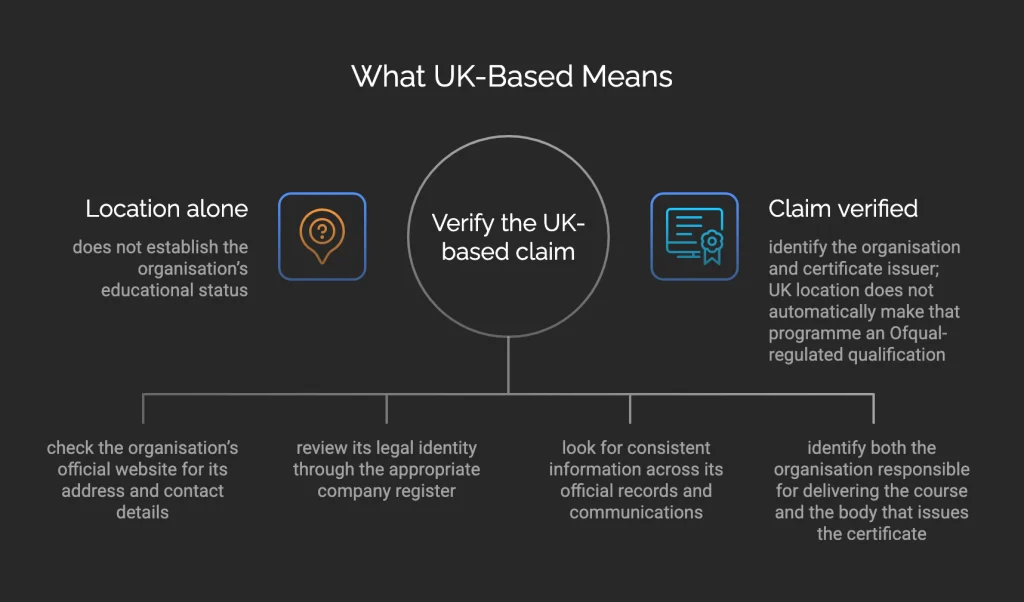
However, the phrase does not, by itself, establish the organisation’s educational status. A UK-based training provider could deliver short courses, professional development programmes, internally developed training or qualifications awarded by another organisation. Whether its courses are regulated depends on the relevant awarding arrangements, qualification status and applicable regulatory requirements, rather than location alone.
To verify a UK-based claim, check the organisation’s official website for its address and contact details. Where relevant, review its legal identity through the appropriate company register. Look for consistent information across its official records and communications, and identify both the organisation responsible for delivering the course and the body that issues the certificate.
For example, a training centre might operate in London but deliver a programme developed by an independent organisation. Its UK location does not automatically make that programme an Ofqual-regulated qualification.
What Does UK-Registered Mean?
“UK-registered” means that an organisation, business or provider appears on a particular register. However, the meaning depends on the register involved. A company registered with Companies House has a legal business registration in the UK, while a learning provider listed on the UK Register of Learning Providers (UKRLP) has a UK Provider Reference Number (UKPRN). These registrations serve different purposes and should not be treated as interchangeable.
A UKPRN helps identify a learning provider in the relevant education data system. It is not, by itself, proof that the provider has received government approval, educational accreditation or Ofqual regulation. Similarly, company registration does not establish that a business has met the requirements for awarding regulated qualifications.
To verify a registration claim, identify the exact registration being referenced. If the organisation provides a company number, check it against the official Companies House register. If it provides a UKPRN, look for the provider on the UKRLP. Compare the registered name and available details with the organisation’s website. If the names differ, ask the provider to explain the relationship between the registered entity and the institution advertising the course.
It is also important to check the qualification separately. Registration of a provider and the regulatory status of a qualification are two different matters.
What Does Accredited Mean?
Accreditation generally refers to an assessment or recognition process in which an organisation, programme or qualification is evaluated against specified criteria. However, the term can mean different things depending on who provides the accreditation and what is being assessed.
The organisation granting the accreditation, the scope of the assessment and the standards applied all matter. Institutional accreditation or recognition relates to the institution itself. Depending on the accrediting body’s process, the review may consider governance, documentation, educational delivery, assessment practices and internal quality assurance. However, recognition of an institution does not automatically mean that every course it delivers is independently accredited or regulated.
Programme-level accreditation focuses on a particular course or training programme. The review may consider curriculum structure, learning outcomes, assessment methods and other criteria defined by the accrediting organisation. Providers should clarify which programmes have been reviewed and whether the recognition covers the complete course, a particular component or a defined period.
Qualification accreditation has a more specific meaning depending on the organisation responsible and the applicable regulatory framework. In England, Ofqual explains that it does not generally accredit or endorse organisations. Instead, it recognises awarding organisations and accredits individual qualifications where an accreditation requirement applies. Therefore, private or independent accreditation should not automatically be presented as Ofqual accreditation.
Before relying on an accreditation claim, establish who granted it and check the accrediting body’s official information. Determine whether recognition applies to the institution, programme or qualification, and review the published standards or assessment procedures. Where possible, use the accrediting body’s directory, certificate verification facility or official confirmation to establish the current status.
Be cautious if a provider uses a logo without identifying the accrediting body, does not explain the scope of recognition or suggests that accreditation guarantees employment, immigration approval or acceptance by every university. Recognition under one organisation’s process does not automatically establish government regulation, equivalence to a UK degree or universal acceptance.
What Does Regulated Mean?
In education, “regulated” has a more specific meaning than simply being recognised or accredited. A regulated qualification falls within the remit of the relevant qualifications regulator and can be checked against the appropriate official register.
For England, Ofqual regulates qualifications and awarding organisations within its remit. The Register of Regulated Qualifications allows users to check qualification details, including the awarding organisation and available information about the qualification. The register includes regulated qualifications in England and Northern Ireland. Wales and Scotland have their own relevant regulatory arrangements, so the appropriate register depends on where the qualification is regulated.
What Is an Ofqual-Regulated Qualification?
An Ofqual-regulated qualification is a qualification regulated by Ofqual under the applicable framework. To verify a claim, search for the specific qualification rather than relying only on the provider’s name or promotional wording. Check the qualification title, awarding organisation and other available details to ensure that the information matches the course or certificate being advertised.
A provider may deliver a regulated qualification awarded by a recognised awarding organisation. In that situation, the provider delivering the training and the organisation awarding the qualification may be different entities. Identifying both helps learners understand who provides the training and who is responsible for the qualification.
What Are Regulated Qualification Levels?
The Regulated Qualifications Framework (RQF) is used in England and Northern Ireland to describe the size and level of regulated qualifications. The level indicates the qualification’s relative demand or complexity within that framework.
However, a number assigned through an organisation’s own programme-review system does not automatically correspond to an RQF level. The framework and the authority behind the level must be identified before making a comparison. For example, a provider may classify its programmes using an internal six-level structure. Those levels should not be described as RQF levels unless that relationship is properly established and supported.
Does Regulation Apply to the Entire Training Centre?
Not necessarily. A qualification can be regulated without every course offered by its delivery centre being regulated. Likewise, a training provider’s registration or accreditation does not automatically make all its programmes regulated qualifications.
The specific qualification, awarding organisation and applicable regulator must be checked. Regulation also does not guarantee employment, professional licensing or acceptance by every employer or institution. Anyone who needs a qualification for a particular purpose should confirm the relevant requirements with the organisation that will assess it.
UK Accredited vs Regulated: Key Differences
| Term | What it tells you | What it does not prove | How to verify |
| UK-based | The organisation claims a UK presence | Accreditation or qualification regulation | Check official address and relevant records |
| UK-registered | The organisation appears on a specified register | Government educational approval or regulated qualifications | Check the relevant company or provider register |
| Accredited | An institution or programme has received recognition under a stated process | Ofqual regulation or universal acceptance | Verify the accrediting body, scope and criteria |
| Regulated | A qualification falls within a relevant regulatory framework | That every course from the provider is regulated | Search the appropriate official qualification register |
These terms refer to different aspects of an educational organisation or offering. They should not be used interchangeably. Always verify the specific claim rather than assuming one status establishes another.
How to Verify UK Educational Claims in Five Minutes
You do not need to rely on promotional wording alone. A few targeted checks can help you understand what an organisation’s claims actually mean.
Step 1: Identify the exact claim. Determine whether the organisation is describing its location, business registration, institutional accreditation or a regulated qualification. Write down the specific status it claims.
Step 2: Check the organisation’s identity. Compare its name and details with the relevant official company or learning-provider register. Remember that registration alone does not confirm educational accreditation or qualification regulation.
Step 3: Identify the awarding organisation. Ask who issues the certificate. The training provider, accrediting body and awarding organisation may be different entities, so do not assume they are the same.
Step 4: Search the qualification register. If the provider claims that a qualification is Ofqual-regulated, search the official Register of Regulated Qualifications. Check the exact title and awarding organisation. For qualifications regulated elsewhere in the UK, use the appropriate register for that nation.
Step 5: Confirm the scope of accreditation. If a private or independent body has accredited the institution or programme, review its published criteria and verification process. Confirm whether the recognition applies to the institution, the specific programme or another defined area.
If a claim cannot be verified through the available information, ask the organisation for written clarification before relying on it. A professional provider should be able to explain its status, the scope of its recognition and the route available for verification.
Where UKIQ Fits
UK International Qualifications (UKIQ) describes its services as including accreditation, recognition, quality assurance, certification and support for training providers and educational institutions. Its website also identifies its UK Register of Learning Providers number.
These details should be understood within their specific scope. UKRLP listing and a UKPRN identify a learning provider in the relevant register; they do not independently establish that its qualifications are Ofqual-regulated.
UKIQ’s published accreditation information describes an institutional and programme-quality review approach. Its qualifications page also explains that its six-level programme-review framework indicates the expected complexity and learning requirements of programmes reviewed under that framework. Those levels should not be interpreted as confirmation that a programme is a UK-regulated qualification or directly equivalent to a GCSE, A level, diploma or university degree.
For training providers considering UKIQ recognition, the appropriate approach is to review the published accreditation requirements, understand what is assessed and confirm the exact scope of any recognition granted. For learners, it is equally important to check the course, certificate and awarding arrangements relevant to their own goals.
Acceptance of a certificate can depend on the employer, institution, professional body or other organisation assessing it. Anyone who needs a qualification for a specific career, further study or professional requirement should confirm acceptance with the relevant organisation before enrolling.
Explore UKIQ’s accreditation services to learn more about its recognition approach, assessment criteria and applicable requirements.