The UKIQ 12-Month Rule: How to Structure a Skill-Course Syllabus for Committee Review

Understanding the UKIQ 12-Month Rule
The UKIQ 12-month rule is an important consideration for training providers preparing skill-development courses for submission through the UK International Qualifications (UKIQ) partnership process. Before preparing a course list or syllabus, providers should understand the duration limit, identify eligible programmes and ensure that the information submitted accurately describes each course. Careful preparation can help reduce avoidable queries during the review process.
According to UKIQ’s published partner guidance, courses submitted under the skill-development course category should have a duration of 12 months or less. Courses extending beyond 12 months should not be presented as skill-development courses under this particular process. Providers should therefore review their programme portfolio before deciding which courses to include in their submission.
The rule concerns the duration of the course being submitted through this process. It should not be confused with an annual quality-assurance review or interpreted as a universal 12-month expiry period for every form of UKIQ recognition. These are separate matters, and providers should refer to the applicable UKIQ documentation for the conditions that apply to their institution and approved programmes.
Understanding this distinction at the beginning helps providers prepare an accurate course list. If a programme exceeds the stated duration limit, its eligibility and the appropriate route should be clarified with UKIQ rather than changing the duration on paper simply to fit the requirement.
Why Course Duration and Syllabus Structure Matter
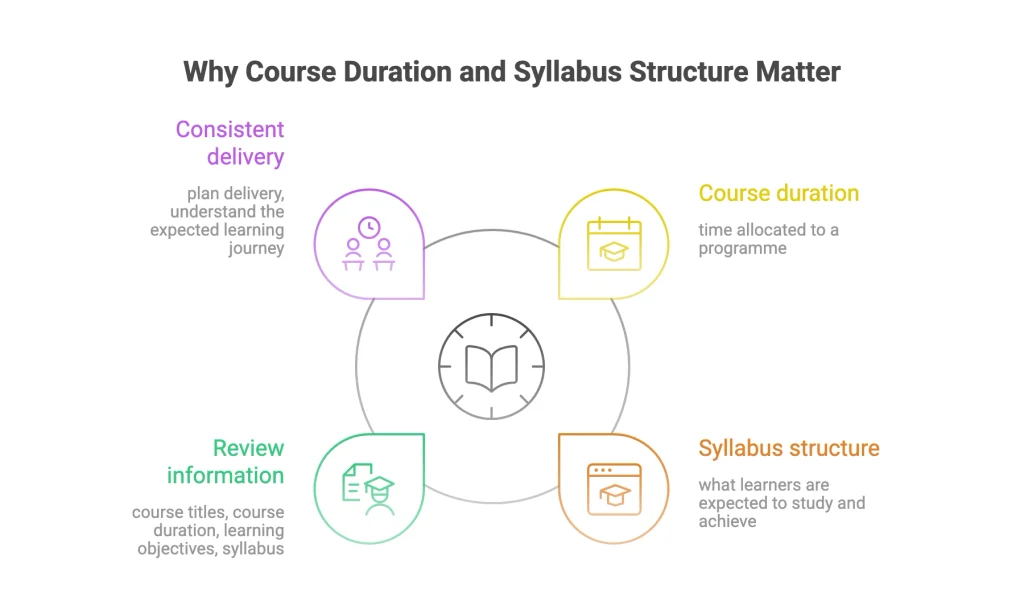
Course duration gives reviewers an overview of the time allocated to a programme, while the syllabus explains what learners are expected to study and achieve during that period. These details need to be consistent. A course described as a short-term skills programme should have a realistic scope, clearly defined learning objectives and a syllabus that can be delivered within the stated duration.
For example, a digital marketing course might cover search engine optimisation, social media marketing, content planning and campaign reporting. The syllabus should explain how these topics are organised, what learners will be able to do after completing them and how their learning will be assessed. Simply listing subject names does not fully explain the structure or expected outcomes of the programme.
UKIQ’s published guidance identifies course titles, course duration, learning objectives, syllabus, assessment methodology, entry requirements and trainer or faculty details as information that may be required for course review. Providers should confirm the precise documentation required for their submission and prepare it in the requested format.
A well-organised syllabus also helps a training provider maintain consistency after a course is approved. Trainers can use it to plan delivery, learners can understand the expected learning journey, and academic managers can compare planned teaching with actual delivery and assessment.
How to Structure a Syllabus for Accreditation Review
A syllabus should present the course in a logical order, beginning with its identity and purpose before explaining the learning content, delivery approach and assessment arrangements. There is no need to make the document unnecessarily complicated. The priority is to make the programme understandable, coherent and supported by relevant information.
Start with the Course Title and Overview
Use a clear course title that accurately represents the content and level of the programme. UKIQ’s partner guidance advises institutions to distinguish consistently between certificate and diploma course titles. For example, a programme may be named “Certificate in Digital Marketing” if that accurately reflects the award being offered. The title should remain consistent across the course list, syllabus and supporting documents.
The course overview should briefly explain the purpose of the programme, its intended audience and the skills or knowledge it aims to develop. Avoid broad descriptions that could apply to almost any course. A practical programme should communicate what learners will study and how the learning relates to its intended field.
The overview should also state the course duration clearly. Make sure the duration matches the course list and any other submitted documents. If the programme is delivered through different modes or schedules, explain the arrangement accurately and confirm with UKIQ what details are required.
Define the Learning Objectives
Learning objectives describe what learners should know or be able to do after completing the course. They should be specific enough to guide teaching and assessment. Objectives such as “understand social media” are too broad to show what successful learning looks like.
A clearer objective might state that learners will be able to develop a social media content plan for a defined audience, select suitable performance measures and interpret basic campaign results. Such wording identifies an observable outcome that can be addressed through teaching activities and assessed through practical work.
The objectives should reflect the actual scope of the course. A short programme should not promise advanced professional competence if the available learning time and assessment activities do not support that expectation. When the objectives, course content and assessment methods align, the syllabus presents a more coherent programme for review.
Organise the Course into Modules or Units
Once the objectives are defined, divide the syllabus into modules or units that follow a sensible learning sequence. Each module should have a clear purpose and contribute to the overall course outcomes. Begin with foundational knowledge where necessary, then progress towards practical application and more complex tasks.
For a digital marketing programme, the sequence might begin with marketing principles and audience research before moving to content planning, search engine optimisation, social media campaigns and performance reporting. A technical or vocational course would require a different structure based on its own subject area and practical requirements.
For each module, explain the main topics and the intended learning outcomes. Where appropriate, include the planned duration or allocation of learning time, practical activities and assessment methods. These details are recommended syllabus-design practices; providers should confirm whether UKIQ requires a particular format or additional fields for their course category.
The amount of content should be realistic for the stated duration. Overloading a short course with too many topics can make it difficult to deliver the planned learning outcomes. Conversely, a syllabus with very limited detail may not give reviewers enough information to understand the programme’s scope.
Explain Teaching and Learning Methods
The syllabus should describe how the course will be delivered. Depending on the subject, this may involve instructor-led sessions, demonstrations, guided practice, workshops, case studies, assignments or supervised practical tasks. Online and blended programmes may also be considered, subject to the relevant requirements and the provider’s ability to demonstrate appropriate delivery and learner-verification arrangements.
Choose methods that support the stated objectives. A course intended to develop practical skills should provide opportunities for learners to practise those skills, not rely exclusively on theoretical explanations. For example, learners studying website optimisation could review a sample webpage and identify improvements rather than only memorising optimisation terminology.
The teaching approach should also be feasible for the provider’s resources and delivery mode. If specialist software, equipment, learning materials or access to a digital platform is necessary, the provider should understand what is needed to deliver the programme consistently.
Describe Assessment and Evaluation
Assessment explains how the provider will determine whether learners have achieved the intended outcomes. The methods should suit the subject and the skills being taught. Depending on the course, assessment may involve written assignments, quizzes, practical demonstrations, projects, presentations or other appropriate methods.
The syllabus should make the relationship between learning objectives and assessment clear. If learners are expected to demonstrate a practical skill, the assessment should provide a suitable opportunity to demonstrate it. For a course in graphic design, for instance, a practical project may be more relevant to certain learning objectives than a multiple-choice test alone.
Where appropriate, providers should also explain how work will be evaluated, what constitutes satisfactory performance and whether reassessment is permitted under the institution’s policies. These arrangements should be consistent with the provider’s actual assessment procedures and the requirements applicable to the programme.
Include Entry Requirements and Trainer Details
Entry requirements should explain whether learners need prior knowledge, qualifications, experience or specific resources to participate successfully. If the course is suitable for beginners, state that clearly. If learners need existing technical skills, identify them rather than leaving applicants to guess.
Trainer or faculty details should accurately represent the people responsible for delivering the course. Relevant qualifications, professional experience, subject expertise and teaching competence can help demonstrate that the provider has suitable personnel. UKIQ identifies trainer or faculty information as a possible part of course documentation, while the applicable requirements may vary according to the programme and review process.
Preparing the Syllabus for Submission
A syllabus should be treated as part of a wider submission rather than as an isolated document. The course list, programme title, duration, objectives and supporting information should tell the same story. Differences between documents can create uncertainty, even when the course itself is well designed.
For example, if the course list describes a six-month programme but the syllabus describes a twelve-month delivery schedule, the provider should resolve the inconsistency before submitting the documents. Similarly, a certificate course should not be described as a diploma elsewhere in the submission unless the distinction is intentional and accurately explained.
UKIQ’s partner guidance states that complete syllabuses should be prepared for the courses being submitted, with PDF or DOC/DOCX identified as accepted formats in its published preparation guidance. Providers should follow the latest instructions they receive and confirm whether any additional forms, supporting evidence or file requirements apply to their application.
Document control is also useful. Give the syllabus a clear title, record its version and date, and identify the person responsible for maintaining it. If the curriculum changes later, update the document systematically so trainers and administrators can identify the current version. This is a practical quality-management recommendation, rather than a claim that UKIQ mandates a particular version-control template.
Planning for the Course Accreditation Committee Review
Preparing for review begins with checking eligibility and gathering accurate information. Providers should first identify the courses intended for submission and confirm that each skill-development course falls within the published 12-month duration limit. They can then finalise the course titles, prepare the complete syllabuses and assemble the other information requested by UKIQ.
A practical internal schedule can help teams complete these tasks without rushing. For example, a provider might use the first stage to review course eligibility and titles, the next stage to develop or revise the syllabus, and the final stage to check consistency and assemble documents. The timing should reflect the size of the course portfolio, the availability of trainers and the amount of revision required.
This is an example of internal planning, not an official UKIQ submission timetable. Providers should not assume that UKIQ publishes fixed committee dates or guarantees a particular decision period unless such details are confirmed directly for their application.
Once submitted, programme information may undergo committee review and relevant checks. UKIQ may request additional information or corrections, and an application is not automatically approved simply because documents have been submitted. Processing time can depend on the completeness of the documentation and the verification required.
For this reason, providers should leave enough time for internal review and possible revisions. They should also ensure that the contact details supplied in their application are accurate and monitored, so that requests for clarification can be handled promptly.
Common Reasons a Submission May Need Clarification
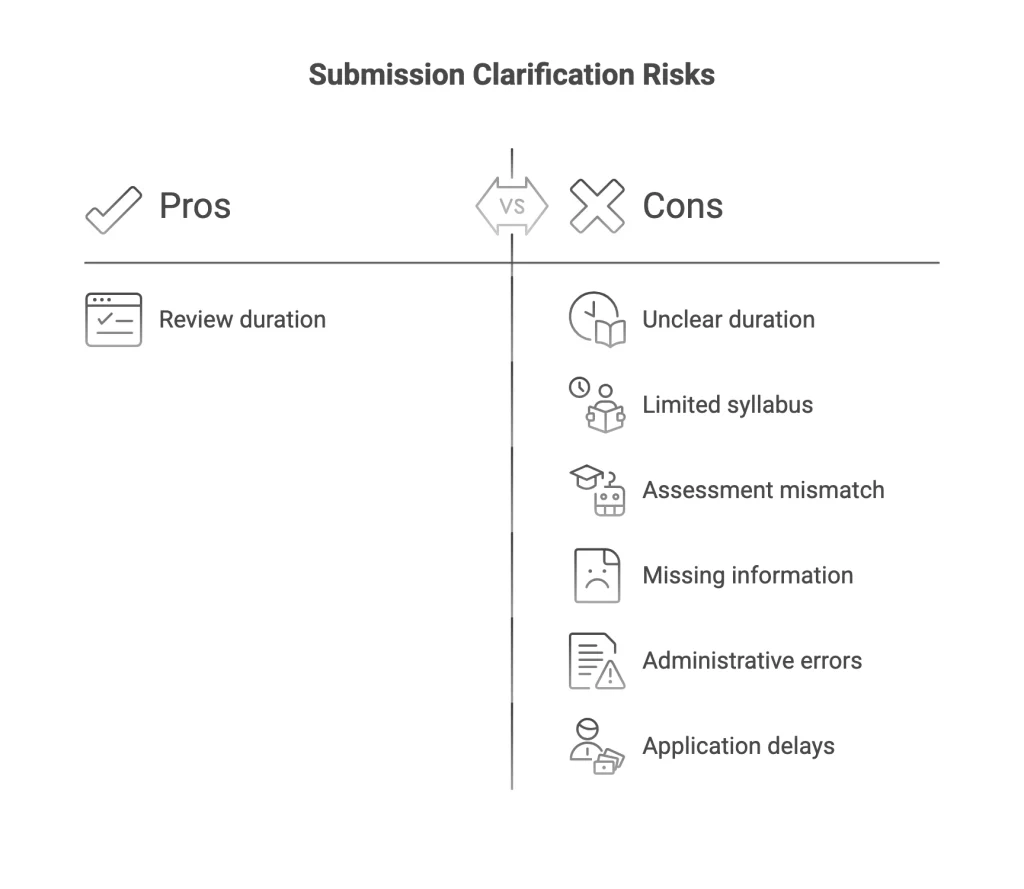
One potential problem is an unclear or inconsistent course duration. A provider may describe the programme differently in its course list and syllabus, or submit a course that exceeds the duration limit for the skill-development category. Reviewing duration and eligibility before submission can help avoid this type of issue.
Another problem is a syllabus that lists topics without explaining what learners should achieve. A list of subjects does not necessarily show how learning progresses, how practical competence will be developed or how outcomes will be assessed. Adding relevant objectives, module descriptions and assessment information can make the programme easier to understand.
Inconsistency between learning objectives and assessment is another area worth reviewing. If a course promises practical competence but contains no suitable practical assessment, the provider should reconsider how achievement will be demonstrated. Similarly, unclear entry requirements or incomplete trainer information may leave important questions unanswered.
Administrative errors can also create delays. Different course titles across documents, missing pages, outdated syllabus versions and incomplete supporting information may require clarification. These examples are practical risks to check, not a definitive list of UKIQ rejection reasons. UKIQ’s official guidance confirms that it may request additional documents, place applications on hold or reject applications that do not meet applicable requirements.
The best response is to ensure that every document is accurate, consistent and relevant to the course being submitted. If UKIQ requests a revision, the provider should address the specific issue identified rather than making unrelated changes that could introduce further inconsistencies.
What Happens After Submission?
After the documents have been submitted, providers should follow the communication and verification process explained by UKIQ. If additional information is requested, respond using the instructions provided and ensure that revised documents match the course details already submitted.
Providers should also distinguish between institutional accreditation, course approval and student certification. These are related but separate matters. UKIQ’s published guidance explains that course approval depends on the scope of the institution’s accreditation and the documentation submitted. Institutions may need to submit details of new courses for review before issuing UKIQ-related certificates.
Approval should never be assumed in advance. Providers should wait for the relevant confirmation and documentation before making claims about a course’s approved status or using UKIQ-related branding. The official requirements and permissions provided to the institution should guide any public communication.
Annual quality-assurance review is another separate consideration for institutions covered by the relevant recognition arrangements. Providers should review their own accreditation documentation to understand the applicable review, renewal and validity conditions. The skill-development course duration limit alone does not establish when an institution’s recognition expires.
Prepare Your Skill Course for UKIQ Review
A strong submission starts with understanding the eligibility conditions, presenting a clear course title and duration, and building a syllabus that connects learning objectives, modules, teaching methods and assessment. Consistent documentation helps reviewers understand the programme and gives the provider a clearer basis for delivering and maintaining it.
Before submitting, confirm that the course fits the applicable duration limit, that the syllabus is complete and that all supporting information follows the latest instructions from UKIQ. Where a requirement is unclear, seek confirmation rather than relying on assumptions or treating general syllabus-design advice as an official rule.
Contact UKIQ to confirm the current submission requirements and obtain guidance on preparing your skill-development courses and syllabuses for committee review.